Gas is an operating cost, not a footnote
Every on-chain write pays a fee that moves with network demand. Write less, cap the fee, watch the sender balance and measure cost per successful operation before the first busy day does it for you.
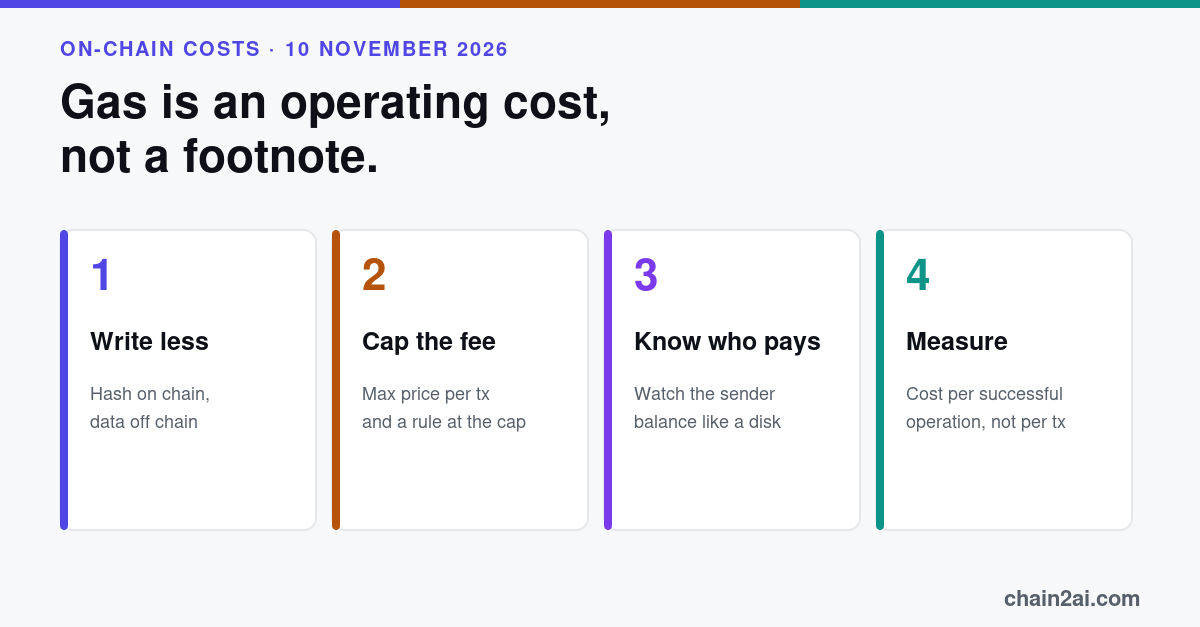
Every write to a blockchain pays a fee, and that fee is set by network demand, not by you. Plan for it like any other running cost, or the first busy day will plan it for you.
What you are actually paying for
A transaction pays for the computation and storage it asks the network to perform. The price per unit moves with demand: when many people want space in the next block, the price rises. Your contract did not change, your code did not change, and the same call costs more. On a test network it costs nothing, which is exactly why teams discover this late. The budget that was approved covered development and deployment. The running cost, which scales with usage and with the weather on the network, was never a line item.
Four design choices that keep it manageable
Write less. Keep the data off chain and publish only a hash, a root or a commitment. Batch: a single transaction that carries many entries spreads the fixed part of the fee across all of them.
Cap the fee. Set a maximum price per transaction and decide in advance what happens when the market is above it. Waiting, retrying later and alerting a person are all legitimate answers. Silently paying whatever is asked is not.
Handle the stuck transaction. A transaction that stays pending blocks the ones behind it on the same account, because they share a sequence number. You need a policy for replacing or cancelling it, and a test that exercises that path.
Know who pays. The account that sends transactions holds a balance and a key. When the balance runs out the system stops writing, often without an error anyone reads. Monitor the balance like free disk space, with a threshold and an owner. If users should not pay fees themselves, a relayer or sponsored-transaction scheme moves the cost to you, which sharpens the budget question instead of removing it.
Choose the chain with the bill in mind
How predictable the fee is depends on the chain and on where the data is finally published. Some networks have steadier fees, and some batch many transactions into one that is posted to a base layer. Each option trades cost against security assumptions and exit options, so it is a design decision, not a deployment detail. Measure cost per successful operation, not per transaction: retries and failures are part of the bill.
What this means for a delivery
Put an expected running cost, a ceiling and an owner for the alert into the project document, next to the development estimate. A client who sees that line at signing is not surprised by it in production.
What does one on-chain write cost your system today, and who gets the alert when it doubles?