A bigger context window is not an architecture
Putting everything in the prompt works for a prototype. In production it moves cost, testing, access control and audit problems instead of removing them. Choose what goes in, filter by permission, and record it.
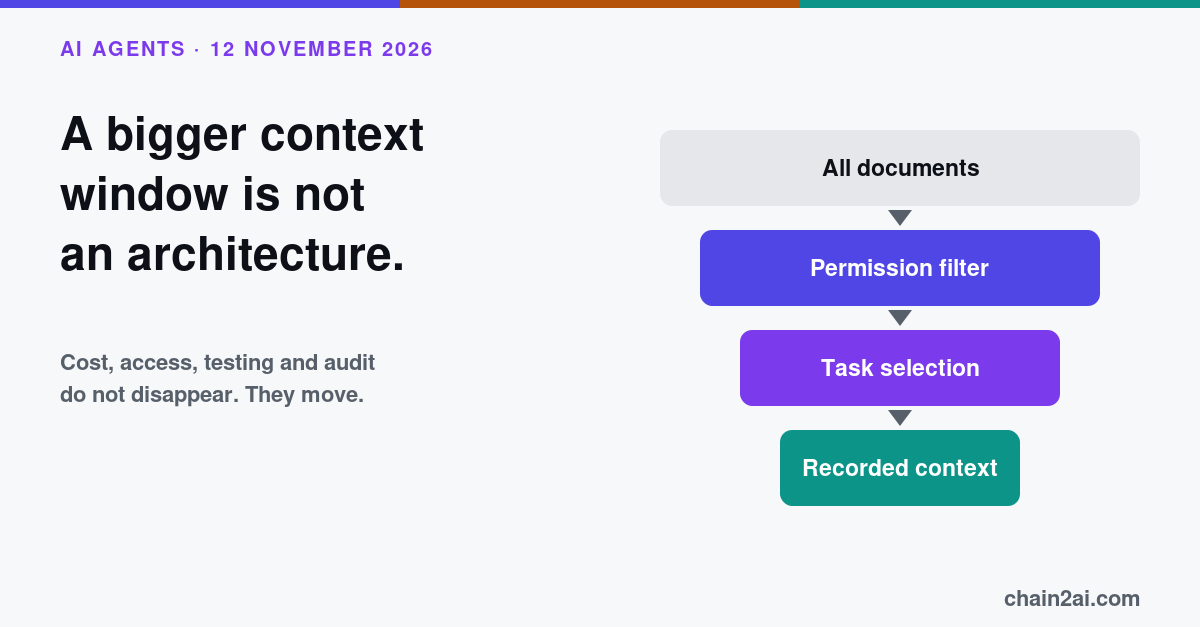
Models now accept very long inputs, so a common shortcut is to skip the retrieval work and put everything in the prompt. For a prototype it works. For a system someone has to run, it moves the problems rather than removing them.
What gets worse as the prompt grows
Cost and latency grow with every token you send, on every call, whether or not the model needed that page. Quality on long inputs can drift: the answer may lean on the wrong passage or miss one in the middle, and you will not see it unless you measure it. Testing gets harder too. When the context is a pile of documents, a change to any one of them is a change to the agent, and the eval set you ran last month no longer describes what is running today.
Access and audit are the quiet problems
Anything in the context can end up in the answer. If the prompt holds documents this user is not allowed to see, you have built a leak and called it convenience. Permission checks belong before the model sees anything, not in an instruction asking it to be discreet. The same pile makes audit weak. When a decision is questioned, "the model saw everything" is not an answer. A reviewer wants to know which documents, in which version, were in front of the model when it decided.
What to do instead
The alternative is unglamorous. For each task, decide what goes in: the few passages, records or rules that the task needs. Filter by the permissions of the person or service on whose behalf the agent acts. Run your eval set on a version with less context and a version with more, and keep the smaller one if the difference does not show. If the larger one really is better on your cases, use it knowingly, and put the cost in the budget.
Then record the identifiers and versions of what was in the context with every decision in the decision log. Months later you can answer what the agent saw, and you can replay the case.
Where a large window does earn its place
There are tasks where the whole document really is the unit of work: reviewing one contract end to end, or summarising one long report. Putting that single document in the context is sensible, and a large window makes it possible without chunking tricks. The point is that the choice is made for the task and measured, not made once for the whole system because the limit allows it.
What this means for a delivery
A large window is useful. It is a budget, not a design. Write down in the project document what goes into the context, who decides it, and how it is measured.
How do you decide what goes into your agent's context today?