Choosing a blockchain is a ten-year decision
Throughput and fees today are the wrong basis for choosing a chain. Ask who can change the rules, what it costs when conditions change, who else can work on it, and how you leave.
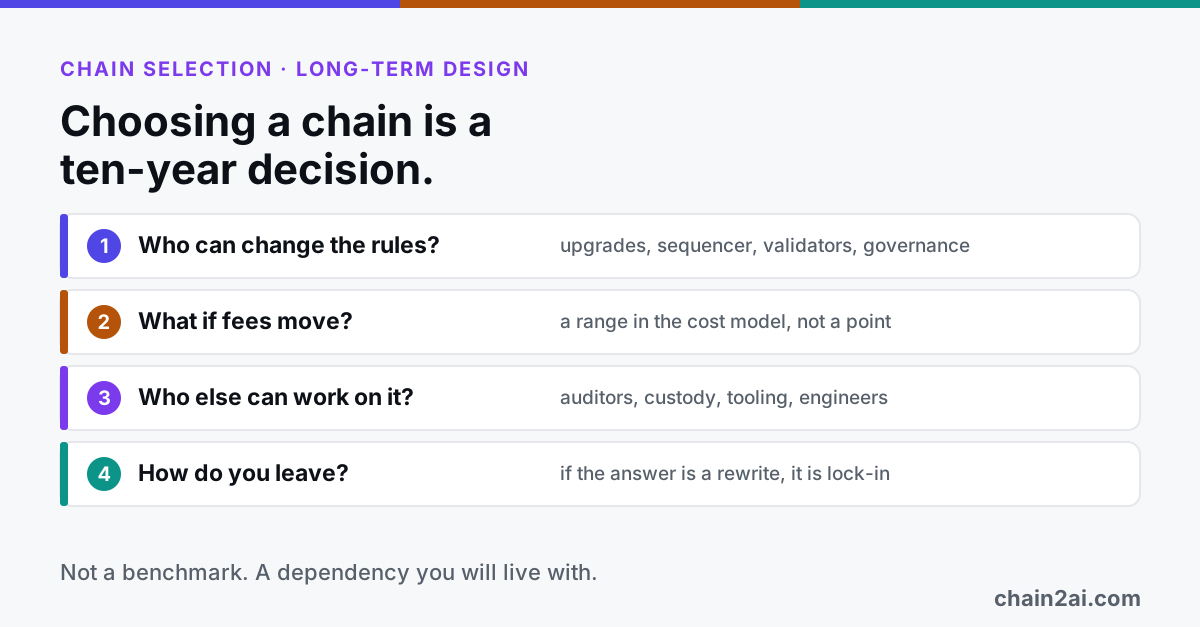
Most conversations about which blockchain to use begin with a comparison table: transactions per second, fees, finality time. Those numbers describe the network this year. The system you are building will outlive them. What you are really choosing is a dependency you will live with for a decade.
Who can change the rules
Every chain has someone who can change its behaviour. It may be a foundation shipping protocol upgrades, a company running the sequencer of a rollup, or a validator set voting on parameters. None of this is bad in itself. The point is to know who decides, how much notice you get, and what happens to contracts already deployed when the rules move. A system that must keep working for years needs that answer written down, not assumed.
What it costs when conditions change
Fees are a market. A cost model that works only at today's fee level is a bet that the level will hold. Build the model with a range instead of a point, and decide in advance what happens to the business case when fees or token prices move against you. Check also who pays: your company, your customer or a sponsor. The answer changes who carries the risk.
Who else can work on it
A platform is also the people around it. Are there auditors who know its contract language and its failure modes? Custody providers that support it? Monitoring tools, indexers, engineers on the market who can join the team? A smaller ecosystem is not a reason to reject a chain, but it is a recurring cost in hiring, review and incident response, and it belongs in the comparison.
How you leave
This is the question rarely asked at the start, and it decides how much the other three matter. If the answer to "what would moving take" is a rewrite, you have not chosen a platform. You have signed a lock-in.
Design the exit from day one. Keep on chain only what needs to be there: state that several parties must verify without trusting each other, or a root that anchors off-chain records. Keep business logic, identifiers and data in formats you can export. Avoid features that exist on one chain only, unless they are the reason you are there. Write down what a migration would touch, and read it again once a year.
None of this needs a verdict on which chain is best. It needs a short document, written before the build, that names the chain, the reasons, the person who will watch for changes in governance and fees, and the migration plan. Reviewed once a year, that page is cheap. Written for the first time during a crisis, it is expensive.
Chosen this way, the chain is a component you picked for stated reasons and can replace, not a bet on a brand.
If you had to move to another chain in three years, what would that migration actually touch?